
I/W: 2026 H: 2021 General, Spirit
In Ezekiel chapters 40-48, Ezekiel spiritually visits a temple and writes a very in-depth account of what he sees and hears. Though its specific location isn’t indicated, looking at his vision in conjunction with other prophecies gives a pretty precise indication of where this temple is. Particularly looking at the description of the river that goes under the temple, explained in Ezekiel 47:1-12. This post will examine this.
At the start of explaining what he saw, Ezekiel clearly states it’s in the land of Israel (Ez 40:2). He also indicates in the prior verse he was brought to the city, presumably Jerusalem, but not stated (Ez 40:1).
In the book of Daniel, a man (ET) named Gabriel informs Daniel that Jerusalem will be rebuilt with a moat (Dan 9:25). Likewise, the temple in Ezekiel has a river that flows under it. So you can presume pretty firmly they’re referring to the same setup, and that this temple is located in Jerusalem.
Things start to get far more concrete when looking at the book of Zechariah.
On that day his feet shall stand on the Mount of Olives that lies before Jerusalem on the east, and the Mount of Olives shall be split in two from east to west by a very wide valley, so that one half of the Mount shall move northward, and the other half southward. Zechariah 14:4
As you match this with the description of the river in Ezekiel 47, I think it becomes pretty clear that the wide valley in Zechariah is the river in Ezekiel 47. Ezekiel describes the river as going east from the temple with its first 1000 cubits being ankle-deep, the next 1000 knee-deep, the next 1000 waist-deep, and the next 1000 deep enough to swim in and that he can’t pass through it. Zechariah also later in the same chapter describes water flowing out east and west from Jerusalem (Zech 14:8).
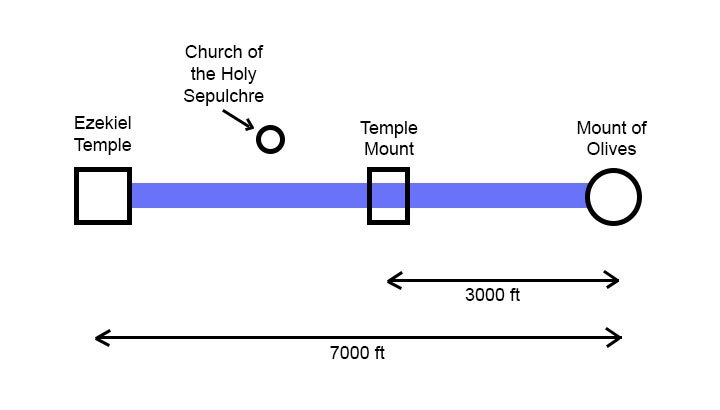
The nature of the wide valley in Zechariah is it will presumably be deepest where “his feet” stand and eventually taper off where the wide valley (split) ends, where it will be most shallow. Ezekiel’s description conveys the temple is near the end of the split, as the river is ankle-deep by it, so you can roughly estimate his measurement ends around the Mount of Olives, the presumed deepest part. That’s 4000 cubits from where he started which is about 7000 feet. Looking at all this, you can roughly estimate Ezekiel’s temple is 7000 feet (2.13 km or 1.33 miles) west of the Mount of Olives, with a possible margin of error of an uncertain amount. I used 21 inches for each cubit, as they’re initially described as long cubits (Ez 40:5).
You can figure out pretty quickly this is a temple to be built in the future. There’s no such river to exist where the temple previously was. The previous location is known because there are remnants of the last one: the temple mount, made for a temple to stand on it, and the western wall, located just west of where the temple was. The last temple, which stood on the temple mount, was destroyed in 70 AD. The previous temple, or rather temples, are believed to stand in the same spot. One pretty clear way to determine this is looking at the dates of the first temple’s destruction and the rebuilding of the next one. I won’t break it down in detail, but the point is, living survivors of the first temple’s time would have been alive when the rebuilding of the temple started (Jer 52:12–13 Ezra 1:1–3, 6:15), so they’d know the location, and presumably have built it in the same spot where the first one was built (1 Chron 21:24–25 2 Sam 24:24 2 Chron 3:1). The first temple’s measurements were recorded and don’t match the one in Ezekiel, and Ezekiel was alive when the first temple was standing, making a spiritual visit unnecessary if it were that one. Perhaps most clearly put, God says he will dwell in this temple forever (Ez 43:6-7), so because no temple currently stands, no past temple meets the description of this one.
The temple in Ezekiel will be located west of where the prior temple stood, the temple mount. God will presumably break the temple mount, as it’s indicated there will be a wide valley where it is, approximately waist-deep. This is, of course, if the temple mount is there when the splitting happens. This will also be a clear indication he doesn’t want the temple mount there, because if he did, he wouldn’t break it, supported by there being no mention of something obstructing the river in Ezekiel. It makes sense he would break it, as he never endorsed it and the temple that was on it. I drew this map to help visualize everything.
God communicated to me that the location of the temple is meaningless. That is to say, nothing is unlocked, and there’s no underlying spiritual element from having it in a specific spot. This is in line with what’s known about the temple too. The Israelites in the desert consistently kept relocating the tabernacle as they traveled. Regardless of this, it will be in the relative vicinity of where it’s historically been.
I think what’s unique about this temple is God will actually co-build it by creating the wide valley that will be the river.
Related Posts
God’s Status With the House of Israel and the Temple
The Goodness of Zion: A Great Contribution to Quality of Life